
Today’s gold benchmark, read against its own range
A single day’s rate answers little on its own. This page places the latest Indian bullion benchmark against the high, low, median and month-ago level of the past four months, so a reader can see at once whether today is a high, a low or the middle.
Today sits inside a four-month band; the live table shows how far it is from the top and the bottom.
The median is the halfway point of the last four months, not the average, and tells you if today is above or below the middle.
The last column counts how many of those days closed lower than the day before, giving a sense of drift rather than a single point.
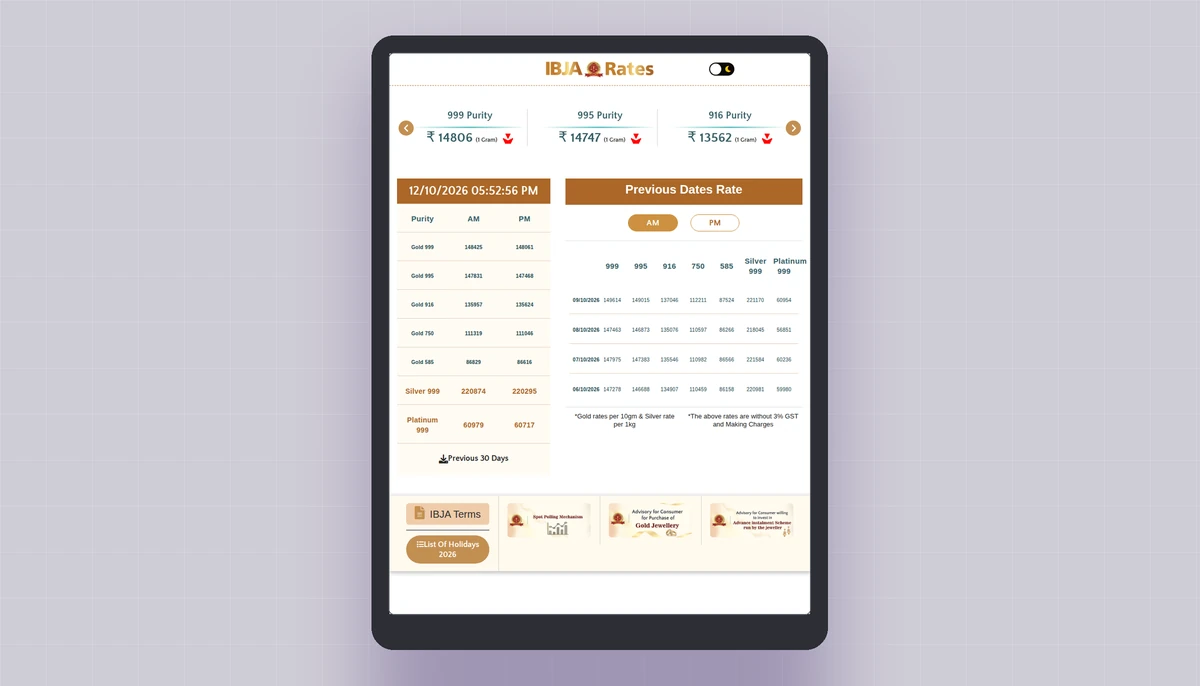
Today against its own four months
Benchmark read: 12.11.2026 13:30| Reference point | Per gram | Against today | Against the high |
|---|---|---|---|
| Today | ₹14,060.30 | +0.00% | -13.29% |
| Four-month high | ₹16,215.40 | +15.33% | +0.00% |
| Four-month low | ₹13,752.40 | -2.19% | -15.19% |
| Four-month median | ₹14,798.00 | +5.25% | -8.74% |
| A month ago | ₹14,764.60 | +5.01% | -8.95% |
| Start of the series | ₹14,218.80 | +1.13% | -12.31% |
Every figure is the association's own published rate for one gram of 999 gold, before tax.
Rates as published by the India Bullion and Jewellers Association (IBJA)
Five things this range tells you
High and low
What the extremes of the last four months mean for someone deciding whether to buy this week.
02What the rate is
The benchmark itself: who publishes it, what it is used for, and why a jeweller’s counter price is not the same thing.
03Why it moves
The four forces that push the Indian rate around, and which of them a buyer can see coming.
04Twice a day
Why the association announces two benchmarks on the same trading day and what that means for an afternoon transaction.
05What this does not tell you
The limits: making charges, a jeweller’s margin and buy-back rates are not published anywhere, and this site does not estimate them.
A rate near the four-month high makes the making charge matter more, not less
When the benchmark sits close to the top of its recent range, the headline number consumes the buyer's attention. The making charge, which is quoted as a percentage of the gold value, also rises in rupee terms even when the percentage stays fixed. A buyer who negotiated a making charge percentage months ago may find the absolute charge is now higher than expected.
The practical consequence is that near the top of the range, a small difference in making charge percentage matters more in rupees. A buyer comparing two jewellers should not compare the percentage alone; the same percentage applied to a higher benchmark produces a larger absolute amount. This is exactly when the charge should be converted into rupees per gram before comparing.
Jewellers know this and often adjust the percentage downward when gold is high to keep the absolute charge stable. A buyer who does not ask for the rupee equivalent may end up paying a higher making charge than necessary, not because the jeweller raised the percentage, but because the base price moved up. The range makes this hidden effect visible.
The gap between today's rate and the four-month low is the real cost of waiting
A buyer who saw the four-month low and waited for a better rate can measure the cost of that waiting by comparing today's level to that low. The difference is not a loss in any accounting sense, but it is the extra rupees per gram paid because of a decision to delay. This gap is the clearest way to see whether waiting helped or hurt.
The range gives this comparison a fixed reference. Without the low, a buyer only knows today's rate is higher than some remembered number. With the low, the buyer can calculate the exact difference and decide whether future waiting is worth the risk. The range turns a vague feeling of having missed out into a concrete figure.
Jewellers often remind buyers of this gap when the rate rises, but the buyer should not rely on the jeweller's framing. The range is published independently, so a buyer can check the low and the current rate without any sales pressure. That independent check is what makes the range useful in a negotiation.
A rate below the four-month median does not mean the metal is cheap
The median is the middle value of the last four months, not a measure of fair value. A rate below the median simply means today is cheaper than more than half of the recent days. It says nothing about whether the price is low in any absolute sense or whether it will stay below the median tomorrow.
Buyers often mistake a below-median rate for a bargain, but the median is a moving reference. If the whole four-month period was unusually high, a below-median rate can still be expensive by any longer-term standard. The median does not know what happened before the four-month window opened.
The useful comparison is not today against the median alone, but today against the median and the low together. If today is below the median but far above the low, the buyer is still paying near the top of the recent range. Only when today is close to the low does the below-median reading suggest a genuinely cheaper day.
The count of down days changes how a buyer should time a purchase
The number of days in the last four months when the benchmark fell rather than rose is a measure of how often buyers had a cheaper opportunity. If the count is low, opportunities to buy on a down day were rare, and a buyer waiting for a down day may have waited a long time. If the count is high, down days were common and waiting was less costly.
A high count of down days does not mean the next day is more likely to fall. Each day's movement is independent in the short term, and the count is only a description of the past. A buyer who sees many down days and expects another is reading a pattern that the market does not promise.
The practical use of the count is to set expectations. A buyer who needs gold for a wedding cannot wait indefinitely, and the count shows how often a better price appeared. If down days were rare, the buyer may accept today's rate rather than risk waiting for a day that seldom comes.
The four-month high is the level at which existing buyers start thinking of selling
When the benchmark approaches the four-month high, a different group of readers pays attention: those who bought at lower levels in the same period. For them, the high is not a price to pay but a price to receive. The range gives them a reference for whether their holding has gained value since purchase.
This selling interest can affect the market, but the benchmark itself does not record it. Jewellers and bullion dealers may see more buy-back inquiries near the top of the range. A buyer who is also a potential seller should know that the buy-back price is always below the benchmark, and the gap may widen near the high.
The range does not tell anyone when to sell, but it tells a seller whether today's rate is historically high within the last four months. A seller who bought at the median and sees today near the high can measure the gain. That measurement requires the range; a single day's rate gives no such context.
A near-low reading shifts the negotiation from the rate to the making charge
When the benchmark is near the four-month low, the gold value is as low as it has been recently. The buyer's attention can then turn to the making charge, which is the only remaining variable in the final price. A jeweller who is reluctant to reduce the making charge when gold is high may be more willing when gold is low, because the total bill is smaller.
The buyer's negotiating position is stronger near the low, not because the jeweller is desperate, but because the buyer's total outlay is lower and the making charge is a larger proportion of the final price. A small percentage reduction in making charge near the low can save more relative to the total bill than the same reduction near the high.
Jewellers know this and may hold the making charge percentage firm, expecting the buyer to focus on the low gold rate. A buyer who still negotiates the making charge near the low is using the range to extract value that the headline rate does not show. The range makes this tactic possible.
The difference between today and a month ago is the only trend a buyer can act on
A single day's rate compared to the previous day is noise. A comparison to a month ago smooths out the daily jumps and shows whether the market has genuinely moved in one direction. The four-month range provides the month-ago figure as a fixed point, and the difference between today and that point is a short-term trend.
This trend is not a forecast, but it changes the buyer's urgency. If today is higher than a month ago, the buyer may feel pressure to act before further rises. If today is lower, the buyer may wait for a better rate. The range does not recommend either course; it only supplies the comparison.
A buyer who ignores the month-ago comparison is reacting to today's number in isolation. The range forces the comparison by presenting both figures side by side. That is the page's core function: to replace a single number with a set of relationships that a buyer can actually use.
The range makes the buy-back price predictable before a buyer walks into the shop
A buyer who later sells gold back to a jeweller receives a price below the benchmark. The exact buy-back price is not published, but it is always derived from the benchmark of the day. The range tells the seller what the benchmark has been over four months, so the seller can estimate the buy-back price before entering the shop.
Jewellers typically deduct a fixed percentage from the benchmark for buy-back, plus a possible purity adjustment. A seller who knows the range can calculate the likely buy-back price for any day in the last four months. This calculation requires the range; a single day's benchmark only gives one data point.
The practical consequence is that a seller can time the sale using the range. If the benchmark is near the four-month high, the buy-back price will be higher than if the benchmark is near the low. The seller does not need to guess; the range provides the reference for an informed decision.
A buyer who ignores the range pays a different price than the benchmark suggests
The published benchmark is a wholesale indicator struck at a particular hour. A retail buyer walking into a shop later that day will not transact at that number. The shop applies its own margin, which covers making charges, overheads, and the cost of holding inventory. That margin is not fixed across the range. Near the four-month high, a jeweller may widen the margin to protect against a sudden fall in the international price before the stock is replenished. The same buyer, on a near-low day, might find the margin narrower because the shop is more eager to move metal.
This means the gap between the benchmark and the counter price changes with where today sits inside the range. On a day that is near the top of the four-month band, the final quote can be noticeably higher than the benchmark plus the usual making charge. On a day near the bottom, the shop may be willing to absorb some of its own costs to close a sale. A buyer who has only seen the benchmark, and not the range, will misjudge whether the shop is being fair. The range gives the context to ask the right question: is today a day when the margin should be wide or narrow.
The failure mode is treating the benchmark as a price list. It is not. It is a reference point from which the retail market diverges, and the divergence is not random. The four-month high and low act as signals to the trade about risk and demand. A near-high reading makes the shop cautious about replacing sold stock at a worse price tomorrow. A near-low reading makes the shop more willing to discount to clear inventory. The buyer who understands this does not expect to pay the benchmark; the buyer expects to pay the benchmark plus a margin that moves with the range.
A range is a reference, not a recommendation
This site gives you the ground truth of where the benchmark sits against its own recent past. It does not tell you what to do with that. Before any purchase, check the shop’s making charge, its buy-back terms and its purity certificate.